From Digital to In-Person: Creating a Seamless Museum Experience
Cuseum · September 3, 2026
A few years ago, museums and cultural organizations faced a difficult question: as visitors returned onsite, how much of the digital engagement developed during the pandemic should remain?
Virtual programs had opened new doors. Audiences could attend talks from home, explore collections online, access educational resources remotely, and engage with institutions from hundreds or even thousands of miles away. At the same time, museums were rediscovering what makes an in-person visit irreplaceable.
The challenge was often framed as a choice between physical and digital.
Today, that distinction matters much less.
Digital engagement is no longer simply an alternative to visiting a museum. It can be part of how someone discovers an institution, plans a visit, navigates the experience, accesses content, becomes a member, and stays connected afterward.
That evolution was already taking shape when Cuseum hosted its Membership Mondays: Engagement Strategies for a Hybrid Era webinar with leaders from the National Aquarium and The Nelson-Atkins Museum of Art. The conversation explored how cultural organizations could preserve the reach and accessibility of digital experiences while rebuilding meaningful onsite engagement.
The technology and visitor expectations have continued to evolve, but the underlying lesson has become even more relevant: museums do not need separate digital and physical engagement strategies.
They need a connected visitor experience.
The American Alliance of Museums has described the post-pandemic visitor journey as an interconnected system of physical and digital touchpoints, noting that digital has moved from simply augmenting museum experiences to becoming a core part of how institutions serve their audiences.
The Visitor Journey Starts Before the Front Door
A museum visit rarely begins when someone walks through the entrance.
It may begin with a Google search, an Instagram post, an email, an online exhibition, an event listing, or a recommendation from a friend.
From there, visitors may explore the website, check hours, purchase tickets, research exhibitions, plan transportation, review accessibility information, or decide what they want to see.
Every one of those interactions shapes expectations before the physical experience begins.
That makes the pre-visit journey an important part of visitor engagement rather than simply an administrative step.
A confusing ticketing process can create friction before someone arrives. Clear information and simple digital access can do the opposite. Personalized recommendations or relevant content can create anticipation and help visitors arrive with a stronger connection to what they are about to experience.
For museums, the opportunity is to stop thinking of these moments as separate transactions and begin thinking about how each one prepares visitors for the next.
Digital Should Make the Physical Experience Better
The rise of digital engagement once created understandable concern that technology might compete with the physical museum experience.
But the most effective digital experiences do not pull visitors away from the museum.
They help visitors engage more deeply with it.
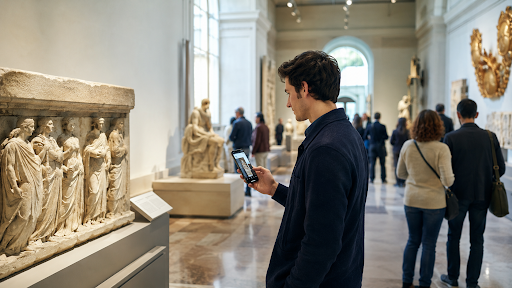
Mobile guides can provide additional context around an artwork or object. Digital wayfinding can help visitors navigate unfamiliar spaces. Multilingual content can make interpretation available to broader audiences. Accessibility features can give visitors more control over how they explore. Digital tickets can remove friction at entry.
The American Alliance of Museums recently highlighted accessible mobile content as one component of multisensory interpretation, noting that content delivered through visitors' own devices can support more autonomous navigation and engagement.
The goal is not to introduce technology everywhere.
It is to identify moments where technology removes a barrier, provides meaningful context, or gives visitors more freedom to shape their own experience.
That is also the philosophy behind effective mobile museum experiences. The phone someone already carries can become a tool for interpretation, accessibility, wayfinding, and engagement without replacing the objects, spaces, and human interactions that brought them to the museum in the first place.
Not Every Experience Needs to Happen Onsite
One of the most important lessons from the original hybrid era was that physical attendance should not be the only way someone can participate in a museum's mission.
Virtual programming dramatically expanded the geographic reach of many cultural organizations. It also created opportunities for people who could not easily visit because of distance, mobility, scheduling, cost, or other barriers.
Those advantages have not disappeared simply because museums have reopened.
The more useful question today is not whether an organization should continue offering virtual programming, but which experiences become more valuable when location is no longer a limitation.
A curator talk might reach hundreds of people online who could never attend in person. Educational resources can continue serving teachers and students long after a physical exhibition closes. Collection stories can reach audiences around the world. Behind-the-scenes programming can give members or supporters access to parts of an institution they would rarely see during a normal visit.
Digital does not have to recreate the onsite experience.
Sometimes its value comes from doing something the physical experience cannot.
Engagement Should Continue After the Visit
Museums put enormous effort into getting visitors through the door.
Marketing campaigns create awareness. Websites provide information. Ticketing systems facilitate admission. Exhibitions and programs create the experience itself.
Then the visitor leaves.
Too often, that is where the relationship becomes quiet.
But leaving the building does not have to mean leaving the museum experience behind.
A visitor who explored a particular exhibition could receive related content afterward. Someone who attended a family program might learn about another upcoming event. A frequent visitor might be introduced to membership. A new member might receive communications that help them understand and use their benefits.
These interactions can transform a single visit into the beginning of a longer relationship.
This is especially important because museums are not only competing for a first visit. They need reasons for people to return. AAM's 2026 review of museum attendance found that while the percentage of U.S. adults visiting museums has recovered beyond pre-pandemic norms, repeat visitation among frequent museum-goers appears to have settled at a lower level than before the pandemic.
That makes the period between visits particularly valuable.
A member lifecycle engagement strategy can help organizations maintain those relationships through relevant communications, event invitations, renewal outreach, and other timely touchpoints rather than waiting for visitors or members to return on their own.
The visit may end at the exit.
The relationship does not have to.
Use Data to Connect the Experience
As museums adopted more digital tools, they also created more sources of information about audience behavior.
Ticketing systems know when people visit. Membership platforms know when people join and renew. Email platforms show what content generates engagement. Mobile experiences can reveal which information visitors find useful.
The challenge today is less about collecting more data and more about connecting what organizations already have.
When systems remain isolated, teams see fragments of the visitor relationship.
When those systems work together, organizations can begin understanding the journey.
A visitor who has attended three times may be a strong membership prospect. A member who regularly participates in family programming may benefit from communications about similar events. Someone who has stopped opening emails or attending programs may need a different kind of outreach before renewal.
Integrating membership, ticketing, CRM, and engagement systems can help organizations create a more complete picture of those relationships. Cuseum's integrations are designed around this principle, connecting digital experiences with the systems museums already use rather than creating another isolated source of information.
Technology becomes more valuable when the information it generates helps improve the next interaction.
Design for Different Ways of Engaging
A connected museum experience does not mean creating the same journey for everyone.
Visitors arrive with different interests, motivations, needs, and expectations.
Some want to explore independently. Others want to participate in programs. Families may prioritize interactive experiences. Members may be looking for deeper access. Tourists may have only a few hours. Digital visitors may never intend to enter the physical building at all.
Recent museum research reinforces how varied those expectations can be.
The 2025 Annual Survey of Museum-Goers found that most museum visits are social experiences, but what people want from those experiences differs significantly. Younger adults and parents were particularly likely to value opportunities to create together or participate in games and challenges, while other visitors placed greater value on exploring exhibitions, conversation, or simply spending meaningful time together.
Digital tools can help organizations support those differences without forcing every visitor through the same experience.
Someone who wants deeper interpretation can access it. Someone who needs another language can choose it. Someone interested in an audio experience can listen. Someone who simply wants to walk through the galleries without looking at a screen can do that too.
The goal is not to prescribe a digital journey.
It is to make the right next step available when someone wants it.
Stop Thinking in Channels
The term "hybrid" was useful when museums were actively deciding how physical and virtual experiences would coexist.
Today, the more important challenge is connection.
Visitors do not necessarily think, "I'm having a digital experience now, and later I'll have an onsite experience."
They experience one organization.
The website, ticket purchase, entrance, exhibition, mobile guide, membership program, email, event, and return visit all contribute to their perception of that organization.
That means the most useful question may no longer be whether an experience should be digital or physical. Instead, museums can ask: does this interaction make the next one easier, more relevant, or more valuable?
Digital engagement has the potential to extend access and remove friction. Physical museums offer something technology cannot reproduce: authentic objects, meaningful spaces, shared experiences, and opportunities for human connection.
The strongest strategy does not ask one to replace the other.
It connects them.
The museums that succeed will not necessarily be those offering the most digital experiences or the most onsite programming. They will be the ones that make the transition between the two feel almost invisible.
Ready to Create a More Connected Visitor Experience?
Cuseum helps museums and cultural organizations connect digital and onsite engagement through mobile engagement solutions, Digital Membership Cards, lifecycle communications, and integrations that help turn individual interactions into stronger, longer-lasting visitor relationships.